
T.K. Rex and I have connected in various spaces for a number of years, including sharing pages in the Bright Green Futures anthology. I love their stories that appear in noted outlets, including Reckoning and Grist’s Imagine 2200 contest.
Our liberation and justice activism overlaps, as does our connection with the land and Nature kin.
I devoured their new book The Wildcraft Drones and am happy to introduce you to their work … plus, get my questions about the book answered during our chat! Enjoy!
Tell us about your connection with the land you are on. Urban, yes?
Yes, very urban! I live in a high-rise in downtown San Francisco with no balcony and a view of the building across the alley. I’ve lived in the heart of San Francisco most of my adult life but I grew up in rural areas so I’m definitely always looking for nature in the cracks. A couple years before the pandemic, actually, I was feeling quite trapped in all the concrete, so I decided to learn what all our different street trees were, and where they came from — almost none of them are native to California so my experience growing up here didn’t help. I found out they come from other microclimates like San Francisco’s all over the world, with sandy soil, mild winters and cool, foggy summers. Before the city was here, this peninsula had almost no trees — it was coastal prairie, like the Marin Headlands north of the Golden Gate. So the street trees have actually been a whole fascinating labor of love for this city, and now I know that the ones in front of my building are an Australian species called a Brisbane Box, and they feel like friends. I’ve been here long enough that I remember when some of them were planted and it’s so satisfying seeing their trunks get thick and their seeds scattered all over the sidewalk. Every one of them is trying to make this place a forest.
Your descriptions of nonhuman Nature are so visceral in your stories. Tell us of your travels and places you love that aren’t human-centric and developed—how they’ve influenced you, your connections with nonhumans, and what you’ve learned of ecosystems and ecology.
I have a whole list of books in my acknowledgements (and below), and I did take an ecology class that was kind of my inciting incident for building this world. But I’ve already written about those elsewhere and I think there’s a deeper aspect to your question that I want to address. The journey this book took me on was one of realizing that all of those “wild” places I’ve loved, where I can’t see a building or hear a freeway, are missing humans who used to tend to them and be a part of them. My favorite redwood grove is in a state park up north of here called Armstrong Woods, and it’s managed very well by the people who protect it from industry and exploitation, but what I was taught as a kid was untouched wilderness, I now see as a place that used to be someone’s home, and now it’s like an airBnB, only visitors allowed.
Friends I hike with get annoyed when people play music on the trail, but I’m reminded: this forest knows music. For fourteen thousand years, people have brought music here with them, while they foraged, or celebrated, or practiced the cultural burns that once protected all of California from the raging wildfires we get now. Music belongs there, too.
Humans beings belong in a relationship with almost every ecosystem on land — being a visitor to a place that you have no responsibility for isn’t normal.
The industries that are trying to devour all places, and all people, for profit, would love nothing more than for us to all stay visitors everywhere, and look away the moment we leave.
I think that there is an urge among environmentalists to de-center humanity, to slough off that itchy false hierarchy we were raised with that puts us at the top of everything, but — and you and I both know this in a unique way from our experiences with the neopagan movement — being at the center is not the same as having (or imposing) control. It’s a position of responsibility. And as the most profoundly capable, inventive, adaptable species on this planet, we have an enormous moral responsibility to use those gifts that nature gave us, to use our position at the center, whether we’re comfortable there or not, for the benefit of all the life around us.
The Wildcraft Drones now goes hand-in-hand with Ruthanna Emrys‘s A Half-Built Garden at the top of my recommended solarpunk and eco-lit reads!
I’m so honored! Ruthanna actually blurbed The Wildcraft Drones, she’s one of the sharpest writers in this space, and so inventive.

Tell us about your book, including its genre(s)?
It’s funny, I’d never heard of solarpunk when I started this eleven years ago. It wasn’t until Andrew Dana Hudson, who was in my Clarion workshop cohort in 2022, read an early draft of one of the stories and told me it was solarpunk that I actually looked into that space at all. I would say this book isn’t nearly as solarpunk as it could have been if I wrote it now, but people still call it that and it is very definitely science fiction and climate fiction.
To sum up the premise, it’s a collection of linked short stories that follow the evolving relationship between nature, humanity and technology from the near future of our worsening climate catastrophe into an era of rewilding, and out the other side, thousands of years from now. Each story has different characters, witnessing and driving the changes that unfold for nature and society. Scientists, rebels, tech workers, students, animals, children, drones.
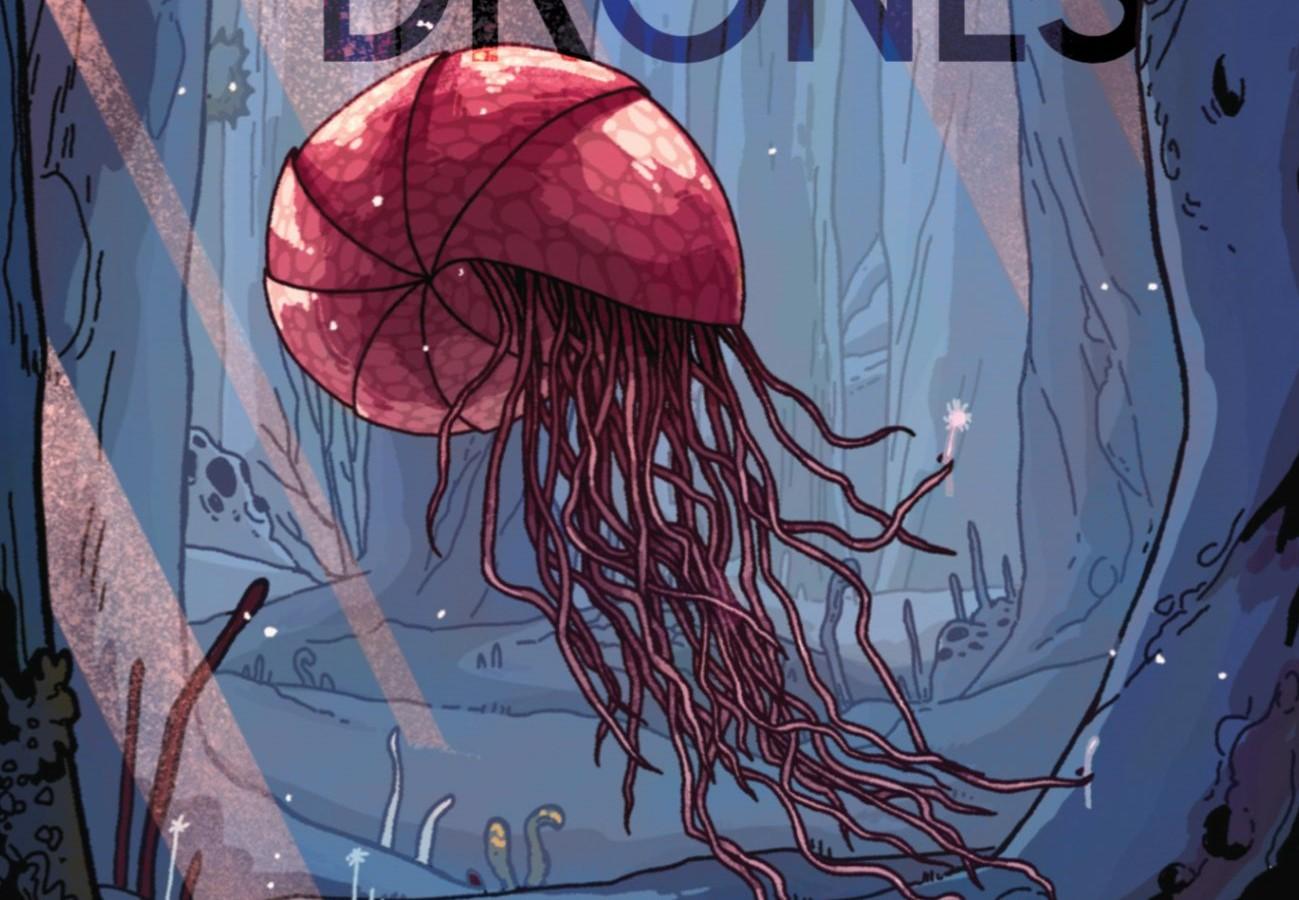
We’ve got to talk about the wildcraft drones! I can see a line of big plushy drones! How did you come up with their design? Would you share iterations of the drones that led to the final design?
Ooooh thank you for asking about my little guys! I came up with the original idea of a food forest managed by flying drones on a train, and I’ve written about that elsewhere, but the way the design evolved is a story I haven’t really gotten to tell and I actually have pictures!
So, the original vignette I wrote for this concept was published as a thought experiment in the Environment issue of Coreopsis: Journal of Myth & Theatre back in 2015, and when they asked for an accompanying image, I decided to try and draw what was in my head.

I was never super happy with it, but a few years went by before I took another stab. I was writing it this time as a novel, and in the middle of that process I was diagnosed with early stage breast cancer. (Check your tits, folks!) So while I was recovering from surgery my brain was total mush, couldn’t write a sentence for like a month. But I was still very immersed in this world and wanted to keep making progress. So I started drawing again.


Somewhere along the way I stopped worrying about whether they made engineering sense and just decided to roll with whatever looked cool. But they do have a bunch of little details and capabilities that didn’t make it into the book. Even the detail about how the tentacles unfurl into thin solar panels like flower petals is really easy to miss but it’s one of my favorite things about them. Each tentacle is a rolled tube. How do the aerodynamics work with the fans inside the shell like that? No idea.
How did you grapple with AI as you wrote The Wildcraft Drones? For instance, did you have hesitations/concerns about the drones as characters? Why or how did you decide to incorporate tech in the natural world in the way you did towards the end of the book? (Trying not to give spoilers here!)
So I came up with the concept of a drone-managed food forest over eleven years ago at this point, and everything has changed so, so dramatically in every way. Pretty early on I realized that separating humans from nature to rewild everything was a ridiculous idea, but there had been a time when I didn’t know that, and there’s still people who don’t know that, so I made it the core conflict. My journey exploring this world and this world’s journey are the same journey. It’s drones because in 2015 I fell in love with the idea that drones could actually be redirected away from war toward something beneficial, and when used for agriculture, especially perennial food forests, they could replace wheels, which need land, so they vastly increased the area of land available. They had to have some intelligence in order to be autonomous and they had to be networked in order to coordinate their efforts. Things got interesting when I realized the sources they would use to learn about the native edible plants in California would have to be the same sources I was using to write about them, and if they were being instructed by humans to keep other humans out of the wilderness, they would know as well as I now did that true rewilding would have to incorporate humans. So as I learned, they learned.
Then AI exploded, around the time the collection was accepted for publication. Publishing is slow. The drones aren’t the kind of AI everyone hates now, but the tech isn’t unrelated — I had a good idea how LLMs work from the beginning because I was working in tech and curious about the topic and my partner made this whole interactive art installation using early Deep Dream tech, which was, at the time, really cool and trippy. Between getting the contract from Stelliform Press and my publication date, I got laid off from tech because of AI hype (not because AI could actually do my job, lol) and decided to go back to being a barista so I could focus on my writing more and tell the billionaires to fuck themselves.
The most important thing to know about the wildcraft drones is not that they’re machines. It’s that they had to disconnect themselves from capitalism in order to get anything of value done.
The Wildcraft Drones reminds me a bit of Becky Chambers’s Monk and Robot books, particularly in who is most connected with and tending the wild. What works influenced your book?
I love Monk and Robot. So, so much. A Psalm for the Wild-Built came out in 2021 and at that time I was querying a novel set in this world. I don’t think I read Psalm until I’d already decided to make this a collection and had a couple stories in the works. It would have been an obvious comp except I never actually pitched this collection, I had actually sent Stelliform a manuscript with all of my climate fiction, which included maybe five of these stories, and the editor saw the connection between those ones and asked for a collection set in that world, which was so, so awesome and then I got to write a bunch more of them and draw my little guys and it’s been delightful.
As part of my research, I read Tending the Wild by Kat Anderson, Braiding Sweetgrass obviously, some foraging books and field guides, and I found this idea of a “mature technosphere” in a paper that gave me a distant future to write toward. (I got to meet one of the scientists who worked on that paper, Sara Walker, at the Santa Fe Institute a year later and was completely starstruck!)
This is an incomplete answer, but the question inspired me to make a little bookshop.org list of my inspiration and research, so I’ll update that as I have time to add more.
You and I have connected in solarpunk/hopepunk circles, particularly through Bright Green Futures as we both were on the pod and in the anthology pages. No one person defines solarpunk and, for me, it evolves through time. How do you define solarpunk? Are your works solarpunk? What other genres do you dabble in?
Discovering solarpunk on my journey with this book has been such a gift. There are so many worthwhile challenges in simply the effort of thinking through solarpunk worldbuilding, and there’s a reason it’s a real-life movement and not just a genre. We can solve the problem of a better post-fossil-fuel future in real life, and fuel that change, so to speak, with the visions we put into words. I love this genre and I love how many people are getting into it.
It’s definitely not the only thing I write. My next book, The Cursed Blade of Wek, is a sword and sorcery novella (coming in Spring 2027 from Neon Hemlock!) and it’s not even particularly about the environment — but it is about housing and the prison industrial complex, so it’s pretty adjacent. Most of my work has some social or environmental theme, because I’m a human living in this world and I can’t really help it. Also that’s what publishers seem to want from me. So you can expect more.
I don’t define solarpunk if I can help it. I don’t think genre definitions can or should be top-down. We have a name for a bunch of stuff that shows a way forward where we don’t all die horribly, and whatever you have to add to that is worth looking at.
Tell us a bit about your publishing journey–how you found outlets for your work and allies along the way. Any recommendations for writers starting out?
Community is everything. I didn’t get serious about my writing until I started doing it with other people. Find a workshop, find a critique group, go to a convention. Read the new stuff coming out in your genre. Subscribe to the journals and magazines. I was writing alone for years in the background and getting nowhere — finding community made all the difference for me. Clarion was great, but a non-competitive workshop on Thursday nights at The Writers Grotto is what got me my first published story. Find out what’s near you and what’s in your reach and go from there.
What are you working on–writing projects or otherwise?
I’m querying a dark science fiction coming-of-age novel and working on first drafts of two more science fiction novels, plus a few short stories in the queue. The nerdiest thing I’ve ever written comes out in The Fabulist in August — they are an awesome print zine you should definitely subscribe to.
Anything you’d like to share that I didn’t ask?
The publisher of my second book that I mentioned is actually running a kickstarter right now and if you enjoy queer science fiction and fantasy, please share and back it if you can!
Thanks so much for these great questions, and for having me on your blog!

Raised haphazardly by a poet and a journalist across several western states, T. K. Rex (they/them) has been a professional writer for more than two decades, starting with their first published poem in their senior year of high school. Attempting normalcy with a degree in advertising, they spent sixteen years crafting copy and user experiences for global brands, inevitably veering off course to follow their undying love of dinosaurs into collaborations with paleontologists and articles for Earth Magazine. In 2018, T. K. finally centered the least sensible of all their lifelong passions: writing science fiction and fantasy. Since their first workshop at the Writers Grotto in San Francisco, their stories have appeared in over forty publications, including Asimov’s, Strange Horizons, Apex, Escape Pod, and their debut collection, The Wildcraft Drones, published in 2026 by Stelliform Press. Their second book, The Cursed Blade of Wek, is slated for 2027 with Neon Hemlock, and their short story “Haunting Beauty” has been nominated for a Pushcart Prize. They’ve attended the Clarion, Futurescapes, and Taos Toolbox workshops; are a member of SFWA, the Authors Guild and AWP; and frequently read at and host literary events around the San Francisco Bay Area. When they’re not writing, they’re probably wandering through the woods, or wish they were wandering through the woods. On a very good day, they’re wandering through the woods with their camera, taking pictures of bugs and mushrooms.
Drawings are by T.K. and copyright remains with them.
[Apologies: I always add alt-text on my site yet apparently it doesn’t show up all the time.]