

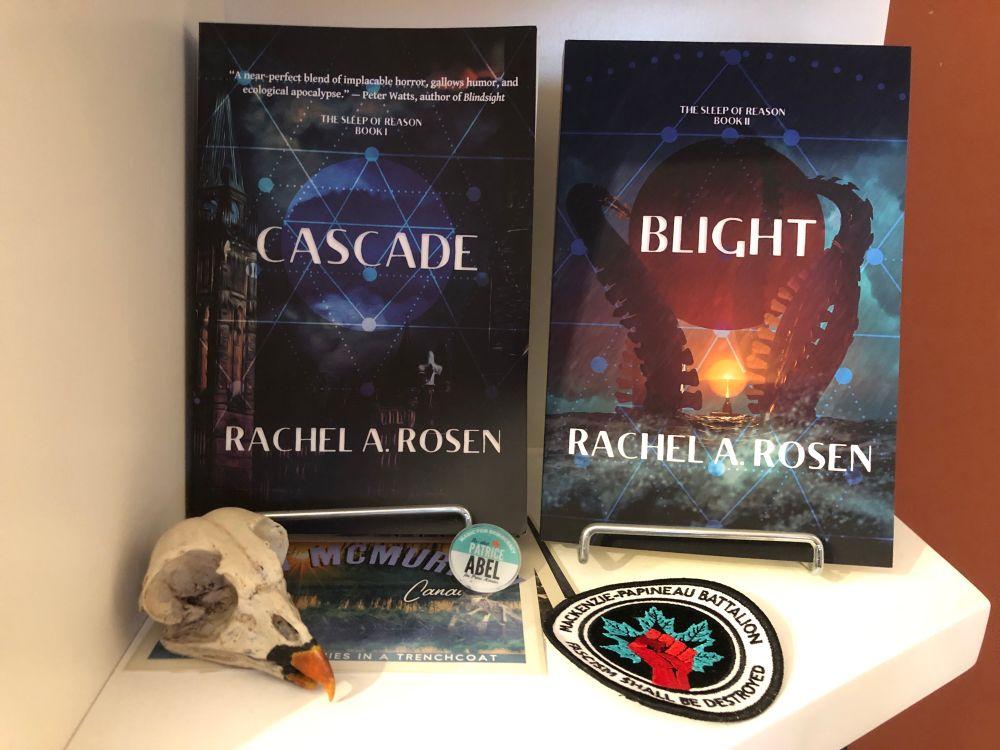
Author and activist Rachel A. Rosen and I have crossed paths in a number of online venues. Mostly, where antifascist, activist writers hang out. I’m pleased to share with you her take on the ills of AI, LLMs, and such—a brilliant framing of these harms as colonization. Her words:
This week, a well-known author who was a formative influence on my young, magic-loving, budding-artist brain posted an impassioned defence of the use of AI in book cover art. For anyone unfortunate enough to be conscious during the last three years, the arguments were familiar territory: LLM [large language model] chatbots are just another art form, the next stage in a continuum from photography to collage to hip hop sampling to Photoshop. Sure, their output is a product of theft, and sure, artists deserve to be compensated for that theft, and yeah, it has some pretty gnarly environmental issues associated with it, but the technology is here to stay, and we’ll have to just learn to use it in an ethical manner. It’s in poor taste these days for a creator to just admit to enjoying the overly glossy, uncanny valley aesthetic of AI slop. Any LLM defender in 2026 must first acknowledge the harms committed by generative AI in the past, present, and future before calling for the reader to embrace it—ethically, of course—as inevitable.

A comparable settler custom, where I live on the stolen territories of the Anishinaabe, the Haudenosaunee, and the Wendat, is to begin each school day with a land acknowledgment. Students grudgingly rise from their chairs to stand, as quietly as they are able, to listen to the announcement. Once radical and controversial, the domain of earnest activists seeking a path towards reconciliation, it is now a daily routine in our institutions. The recitation is codified into school policy, as rote as the national anthem that follows as if to remind us that the acknowledgment is no more than lip service. Children do not so much as step outside to stand physically on the land that we speak of, let alone commit to specific future actions in solidarity with Indigenous peoples. There’s a grim repetition to the ritual, a tacit understanding that we cannot change the past, a reminder that it would probably be more effort than we’re willing to expend to change the present or future.
Even the most imaginative of creatives is prone to discuss generative AI with the same defeatism. They begin by acknowledging its many harms—the waste of water and electricity, the elimination of jobs, the backtracking on climate change commitments, the theft of intellectual property, the disinformation, deepfakes, and propaganda—while acknowledging its value in abstract, its inevitability, and above all a professed belief as strong as religious faith in an ethical use for AI as a tool. Like the school land acknowledgment, there is no need to commit to a personal lifestyle change or engagement with solidarity. Begin by acknowledging the edifice of the stolen work and the stolen earth on which your use of chatbots rests, and with the problems thus acknowledged, we can all move on to the real important stuff. Email summaries won’t write themselves.
Our modern capitalist economy runs on extraction. From the first Enclosure Act of 1773, the accumulation of wealth has been the accumulation of land and resources that had once belonged to the commons—the whole of humanity—to enrich the few. Only a few centuries earlier, the hunger for land and resources had unleashed apocalypse on the people and ecosystems of Turtle Island. Severed from their relationship with their own land, peasants were driven into low-wage factory work or became footsoldiers for colonization around the world. Industrialization saw the ravaging of that land for its black blood, blew the tops off mountains, and launched the sixth mass extinction.
With no corners of the earth left to conquer, the wealthy have nothing left to colonize but the imagination. Generative AI, like fossil fuels, is extractive at its core. Besides its endless appetite for coal and gas, it extracts the fruits of human labour and creativity, hoovering up the entirety of human art, literature, music and communication without credit or compensation in order to extrude profit for the few. Just as the peasants were driven from the commons to Blake’s dark Satanic mills, those who presently produce cultural and intellectual wealth, from artists and writers to journalists and coders, find their relationship to their work and their knowledge severed.
Land is central to every social struggle and tension. Those who have it endlessly hunger for more of it, to squeeze more oil and water and wealth from what they own. The cry for justice has always been in no small part a cry for land, to return it to its rightful owners, to repair our broken connection to it. The poor live in tent cities while the rich dream of blanketing the earth with data centres, and, when there is no more room on earth, set their eyes on space, a Dyson sphere of orbital data centres to keep the line going up, forever.
It is no coincidence that the AI hype bubble has come at a time when we were beginning to make progress on fossil fuel reduction. Naomi Klein frames the forced adoption of AI as a last gasp of the technofascist class, a saving throw by petrol oligarchs to maintain a global demand for fossil fuels.
The enclosure of the commons led to poverty, famine, and genocide, but some would argue that the benefits of industrialization meant eventual higher living standards, the avoidance of a Malthusian nightmare for humanity. The tradeoff with generative AI is less clear. In exchange for our livelihoods, our cultural richness, and the future of our planet, we are given the opportunity to send emails we haven’t written and that the person on the other end won’t read. We are told that this environmentally ruinous technology will, at some point, solve the problem of climate change, despite empirical observation suggesting the opposite. If we don’t teach our children to plagiarize, we’re warned, the technology will never be able to cure cancer. If we keep reciting our acknowledgment of its harms, eventually an ethical means of using it will magically emerge.
My job, as both an educator and as a speculative fiction writer, involves imagining different futures. Not necessarily better futures, as anyone familiar with my work will tell you, but to expand possibilities rather than foreclose on them. Which is why it is painful to see writers—especially writers in speculative genres—simply acquiesce to a future where the fruits of our labour languish in data centres and our human bodies crowd together in tent cities. We can do better than acknowledging. We can imagine, we can organize, and we can resist.

Rachel A. Rosen (she/her) is an activist, graphic designer, and for her sins, a high school teacher. In a previous life, she published two long running anarchist ‘zines and designed the uniform for the Christie Pits Hardball League.
She is the author of Cascade, the first book in The Sleep of Reason trilogy and its sequel, Blight. With Zilla Novikov, she is the co-author of The Sad Bastard Cookbook: Food You Can Make So You Don’t Die.
More of her writing can be found in the Toronto Star, Trollbreath, Beyond Human: Tales of the New Us, Instant Classic (That No One Will Read), Antifa Lit Journal, Anarchist Fictions, and The Dance. Rachel co-hosts the Wizards & Spaceships podcast with David L. Clink.
[copyright of Rachel’s post remains with her]